
Despite leading the world in broadband subscribers, the US dropped from 17th to 20th place in broadband penetration over the past year (see Figures 1 & 2). Due to its slower growth rate the US fell behind Sweden, the UK, and even tiny Luxembourg in broadband uptake from March 2005 to March 2006, according to Point Topic. Meanwhile, US broadband penetration among active Internet users grew 1.34 percentage points to 73.1% in June 2006.
Top 10 Broadband Countries by Subscribers 2005-2006
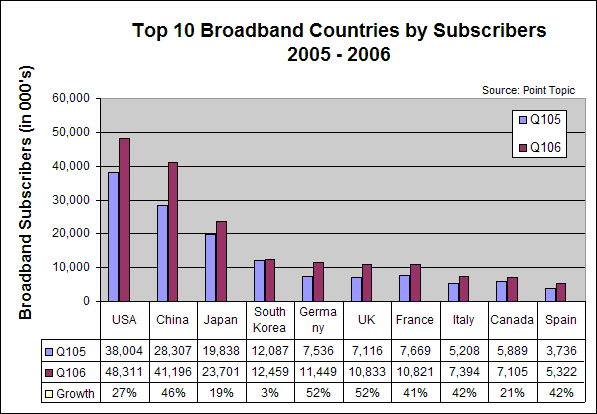
Figure 1: Top 10 Broadband Countries by Subscribers Q1 2005 – Q1 2006
Source: Point Topic
Worldwide Broadband Penetration Trends
Worldwide, from March 2005 to March 2006, the US dropped from 17th to 20th place in broadband penetration among all countries surveyed. While the percentage of broadband households in the US grew by 27.1% over the past year (from 34.97% to 44.45%) the US fell behind Sweden, the UK, and Luxembourg due to their higher broadband growth rates (see Figure 2). UK broadband grew 52.3% from 29.6% to 45.1% penetration, leapfrogging the US from 21st to 18th, while tiny Luxembourg surged nearly 85% over the past year to 19th place. South Korea still leads all countries with 83% broadband penetration, followed by Hong Kong with 80.98%, Iceland at 74%, Israel at 69.08%, and Taiwan at 64.65% penetration.
Top 20 Broadband Countries by Household Penetration 2005-2006
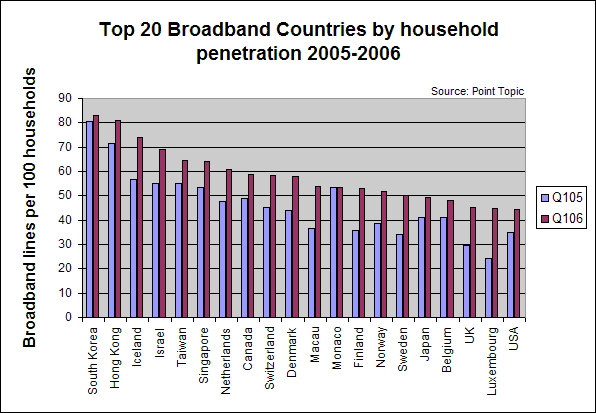
Figure 2: Top 20 Broadband Countries by Household Penetration Q1 2005 – Q1 2006
Source: Point Topic
When measured by broadband takeup per 100 inhabitants, the numbers tell a different story. South Korea at 26 % penetration has lost its lead to three Western European countries: Denmark with 26.5%, Iceland at 26.4%, and the Netherlands at 26.35%. South Korea grew by a negligible amount of 3.1% while Denmark led the top five countries growing by 31.5% over the past year. The US is 19th overall with 16.61 broadband lines per 100 inhabitants behind Luxembourg, and just ahead of Macau (see Figure 3).
Top 20 Broadband Countries by Household Penetration 2005-2006
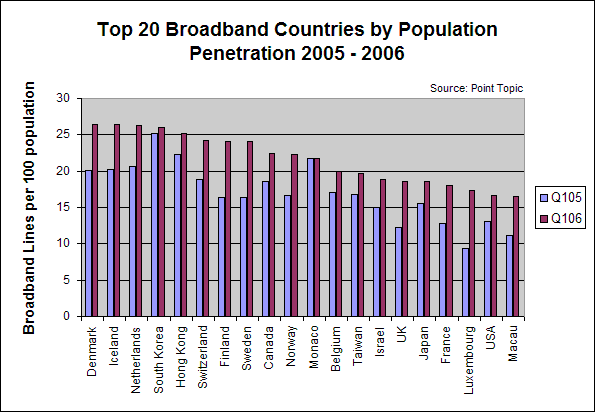
Figure 3: Top 20 Broadband Countries by Population Penetration Q1 2005 – Q1 2006
Source: Point Topic
Home Connectivity in the US
US broadband penetration among active Internet users grew to 73.1% in June 2006. Narrowband users connecting at 56Kbps or less now comprise 26.9% of active Internet users, down 1.34 percentage points from 28.24% in May (see Figure 4).
Web Connection Speed Trends – Home Users (US)
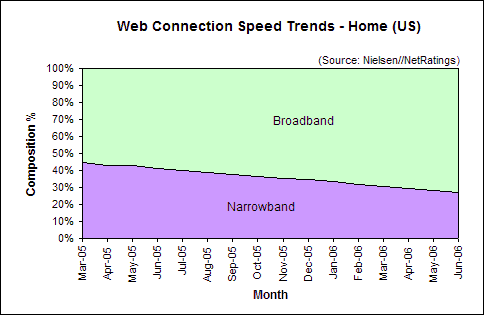
Figure 4: Web Connection Speed Trends – Home Users (US)
Source: Nielsen//NetRatings
Broadband Growth Trends in the US
In June 2006, broadband penetration in US homes jumped 1.34 percentage points to 73.1% up from 71.76% in May. This increase of 1.34 points is above the average increase in broadband of 1.14 points per month over the last six months (see Figure 5). At current growth rates US broadband should break 80% among active Internet users by December 2006. Note that a Nielsen analyst estimates that broadband penetration will plateau at 85% (Tsuruoka 2006).
Broadband Adoption Growth Trend – Home Users (US)
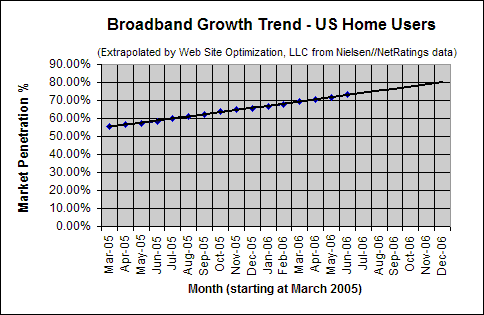
Figure 5: Broadband Adoption Growth Trend – Home Users (US)
Extrapolated from Nielsen//NetRatings data
Work Connectivity
As of June 2006, 89.84% of US workers use broadband, up 0.32 percentage points from the 89.52% share in May.
At work 10.16% connect at 56Kbps or less (see Figure 6).
Web Connection Speed Trends – Work Users (US)
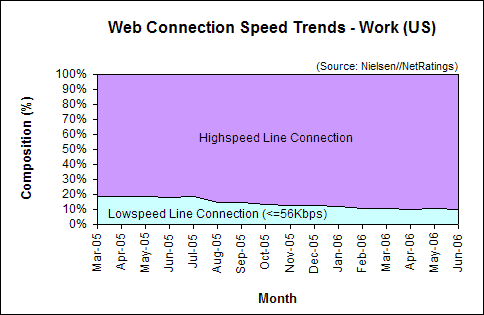
Figure 6: Web Connection Speed Trends – Work Users (US)
Source: Nielsen//NetRatings
Further Reading
- Analyst Expects U.S. Broadband Use Will Max Out At Near 85%
- Joe Gibs, a Nielsen//NetRatings analyst, expects broadband penetration to plateau at 85% in the US. By Doug Tsuruoka, Investors Business Daily July 14, 2006
- Nielsen//NetRatings
- Provided the US broadband penetration data for active Internet users for the Bandwidth Report.
- Point Topic Ltd
- The “World Broadband Statistics Q1 2006,” by Tim Cox of June 2006 provides projections of broadband composition and growth for countries worldwide. The figures were updated by Toby French.
*Note that Nielsen//NetRatings NetSpeed report determines the connection speeds of the Digital Media Universe, which combines Web traffic, Internet applications and proprietary channels.