website optimization

WebSiteOptimization.com

Higher traffic and speed guaranteed.™


Home Sitemap Publications Services About Contact
Newsletter:  
home > bw > 0609
« New Jersey Leads Nation in Broadband Penetration | Main | China to Pass US in Total Broadband Lines »

European Broadband Penetration Gap Widening - US Broadband Penetration Nears 75% Among Active Internet Users - September 2006 Bandwidth Report

Summary: The broadband gap in Europe is widening, according to a recent survey. While Denmark, the Netherlands, and Finland top the EU, Greece, Poland, and Slovakia are trailing in broadband penetration. Meanwhile in the US, broadband penetration among active Internet users neared 75% in August 2006.

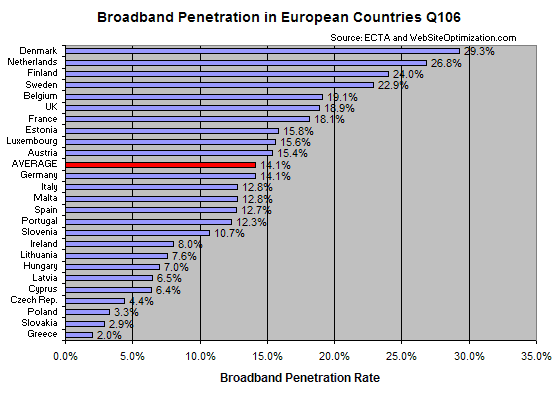
Sixty-four million people now have broadband access across the 25 countries of the European Union - but the gap between the best and worst performers is widening (see Figure 1). Denmark, the Netherlands, and Finland lead the European Union in broadband penetration while Greece, Slovakia, and Poland trail according to a recent broadband survey by ECTA. Back in the US, broadband penetration among active Internet users neared 75% in August 2006.

Evolution of European Broadband Penetration Rates from Q103 to Q106
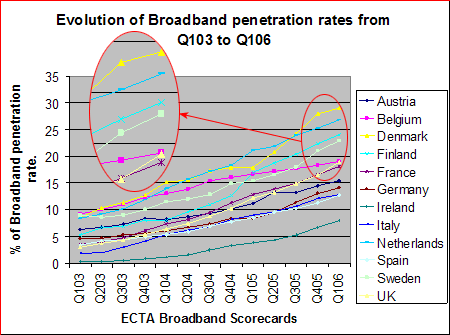
Evolution of European Broadband Penetration Rates from Q103 to Q106

Figure 1: Evolution of European Broadband Penetration Rates from Q103 to Q106
Source: ECTA

EU Broadband Gap Widening

Denmark tops the EU with broadband penetration of 29.3% while last place Greece trails far behind at just 2% (see Figure 2). Broadband uptake in high scoring countries is growing faster than the low scoring countries, widening the gap between wired and unwired countries (see Figure 3). ECTA attributes the widening gap to regulatory action which creates more choice and competition.

Broadband Penetration Rates in European Countries - Q106

Broadband Penetration Rates in European Countries

Figure 2: Broadband Penetration Rates in European Countries
Source: ECTA

Denmark tops the list at 29.3%, followed by the Netherlands at 26.8%, Finland at 24%, Sweden at 22.9%, Belgium at 19.1%, and the UK at 18.9% (see Figure 2). At its current growth rate, the UK is poised to pass Belgium in broadband penetration to become fifth among European countries surveyed (see Figure 1). Greece at 2% broadband penetration, Slovakia at 2.9%, and Poland at 3.3% trail all countries in the EU. Overall, the average broadband penetration rate of the EU is 14.1%, up 5.5 million lines over the 12.9% penetration rate of the previous quarter.

Growth in European Broadband Penetration by Country

Estonia tops the list in broadband penetration growth at 2.56 percentage points over the previous quarter, followed by the UK at 2.39, Sweden at 1.86, Finland at 1.6, the Netherlands at 1.52, and France at 1.45 (see Figure 3). France in particular was cited by ECTA for its regulatory improvement: "broadband in France was stagnating until regulatory action paved the way for competition - triple-play packages are available now for less than €30 per month."

Broadband Penetration Growth in European Countries from Q405 to Q106
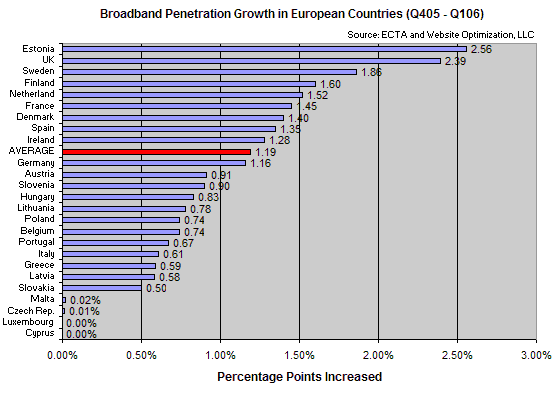
Growth of European Broadband Penetration from Q405 to Q106

Figure 3: Broadband Penetration Growth in European Countries from Q405 to Q106 (by percentage points)
Source: ECTA

Greece, Poland, and Slovakia Lead all Countries in Broadband Line Growth Rates

Despite its last place showing, Greece leads all countries in broadband line growth at 40.3% over the past quarter (see Figure 4). Poland (29.1%), Slovakia (21%), Estonia (19.3%), Ireland (19.0%), and the UK (14.5%) follow Greece in broadband line growth. Countries with low penetration rates can quickly boost their broadband line growth, while countries with widespread broadband uptake typically experience lower growth rates as more of the population has a high-speed connection.

Growth of Broadband Lines in Europe by Country
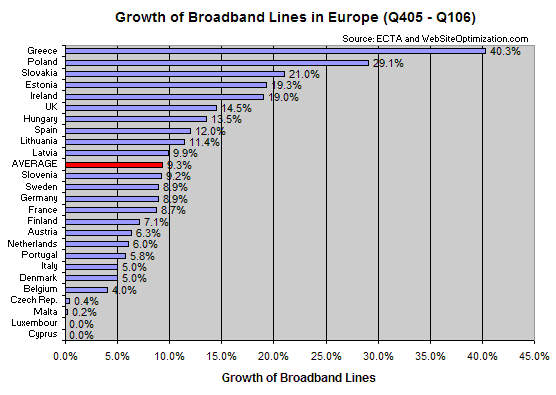
European Broadband Line Growth Rates by Country

Figure 4: European Broadband Line Growth Rates by Country
Source: ECTA

Home Connectivity in the US

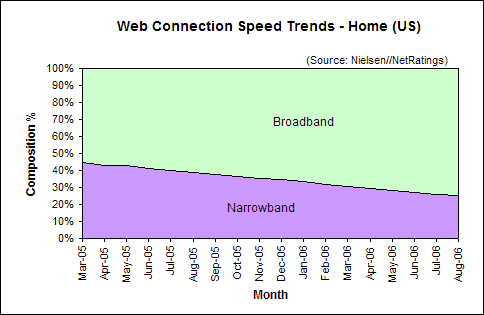
US broadband penetration among active Internet users grew to 74.87% in August 2006. Narrowband users connecting at 56Kbps or less now comprise 25.13% of active Internet users, down 1.01 percentage points from 26.14% in July 2006 (see Figure 5).

Web Connection Speed Trends - Home Users (US)

Web Connection Speed Trends August 2006 - U.S. home users

Figure 5: Web Connection Speed Trends - Home Users (US)
Source: Nielsen//NetRatings

Broadband Growth Trends in the US

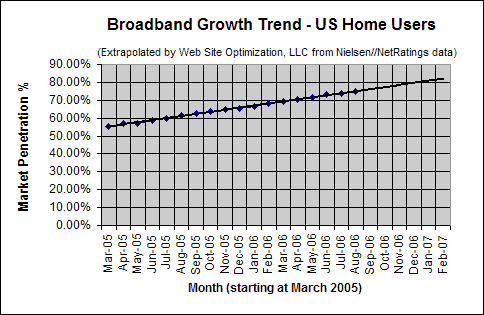
In August 2006, broadband penetration in US homes grew 1.01 percentage points to 74.87% up from 73.86% in July. This increase of 1.01 points is below the average increase in broadband of 1.2 points per month over the last six months (see Figure 6). At current growth rates US broadband penetration should break 80% among active Internet users by December 2006.

Broadband Adoption Growth Trend - Home Users (US)

Broadband Adoption Growth Trend - August 2006 - U.S. home users

Figure 6. Broadband Adoption Growth Trend - Home Users (US)
Extrapolated from Nielsen//NetRatings data

Work Connectivity

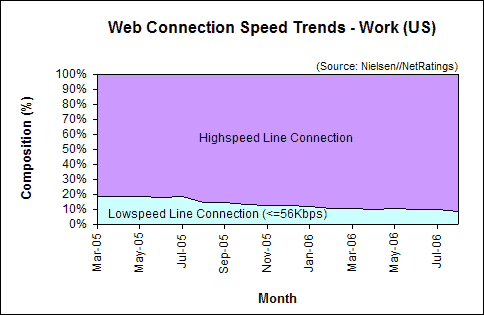
As of August 2006, 91.21% of US workers were on broadband, up 0.89 percentage points from the 90.32% share in July. At work 8.79% connect at 56Kbps or less (see Figure 7).

Web Connection Speed Trends - Work Users (US)

Web Connection Speed Trends - August 2006 - U.S. work users

Figure 7: Web Connection Speed Trends - Work Users (US)
Source: Nielsen//NetRatings

Further Reading

European Competitive Telecommunications Association (ECTA)
Provided the data for EU broadband growth and penetration rates. See their Broadband Scorecard Q106 for details.
Nielsen//NetRatings
Provided the US broadband penetration data for active Internet users for the Bandwidth Report.

By website optimization on 25 Sep 2006 AM

Comments

This is a good site but I would prefer an analysis of each country's broadband and not for all the Europe.

By: Panayiotis at October 10, 2006 2:20 AM

When talking about american penetration of broadband, the report specifies "active" internet users. I wonder if that is leaving out of the statistics all the casual users who only connect once or twice a week, probably a majority of which are still on dial-up.

By: DyNama at October 10, 2006 10:00 AM

DyNama,

You asked about active Internet users versus casual Internet users. Active Internet users are defined by Nielsen//NetRatings as people age 2 years old and higher who used an Internet-enabled computer within the past month. This is from my Nielsen//NetRatings source:

"Basically, we have two universes. The 'current' Internet universe consists of people age 2+ who have an Internet connection, but they may not have logged on. And the 'active' is anyone who logged on at least once. The 'active' is not meant to denote a VERY active user. As long as they logged on at least once, they're considered active."

"The active Internet universe changes for each time period. Thus the active Internet universe will be different for July 2006, for August 2006, for September 2006, etc. It's based on how many people were active for the specific reporting period being measured."

So in our case active means they were on at least once in the past month.

Hope this helps,

By: website optimization at October 19, 2006 9:16 AM

Panayiotis,

We do analyze broadband growth by country here (see Figure 1), and you can find more countries in the Bandwidth Report home page that lists the countries surveyed, each time data is mentioned.

By: website optimization at October 19, 2006 9:21 AM

Hum! The percentages are much less than I expected. I wish there were some breakdown of those statistics by age, education, industry sectors, etc.

By: Normand Peladeau at November 5, 2006 11:57 AM

One of the reasons Denmark is leading the list this year, and probably will remain high on the list for many years, is the fact that the Danish power companies have started to roll out fiber to consumers, as they work to bury overhead power lines. We just had a big merger in Denmark, where many of the major power companies turned into one company called DONG Energy, which is going to speed up the process. They estimate 98% of the population will have access to this within 10 years. I very much welcome this development as my 8Mbit/s line isn't cutting it anymore!

By: Dane at November 10, 2006 12:03 PM

Thank you for providing this information. I'm searching for a list showing the available connection speeds by nation. I'm also searching for the monthly end user cost for such a connection. Example: U.S.A. offers dial up at these ranges of prices. It also offers cable connections in these ranges of speeds at these ranges of costs. Ditto for broadband. Of course, I'd like to be able to compare that to other nations. What speed/cost is considered the norm for EU? Thanks again for having this site.

By: Bunni at April 19, 2007 11:16 AM

Recently the broadband market in Cyprus started to become more competitive with higher speeds and lower prices however it still behind most other EU countries.

Currently ADSL is offered at speeds of up to 4Mbps, while in a few urban locations cable internet is available with speeds of up to 10Mbps.

By: Cyprus Broadband at September 5, 2007 6:22 AM

Post a comment


Remember Me?

(you may use HTML tags for style)